
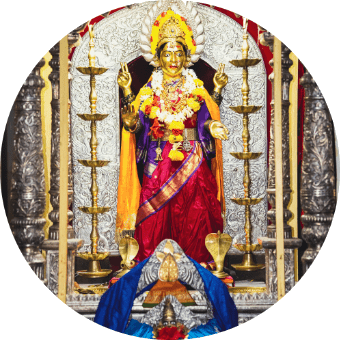
Annual Jatrostav
The cultural history of India is not just written in books but is alive in its vibrant festivals. To preserve this culture, it is essential to instill respect for our ancestors who selflessly dedicated themselves to safeguarding traditions. Festivals, with their profound messages, serve as a guide for our lives and play a significant role in Indian society, becoming an integral part of many people’s lives. The Shree Shantadurga Kunkalikarin Temple’s annual Jatra (festival) is a remarkable example of this cultural heritage.
During the 16th century, Goa witnessed a political upheaval under Portuguese rule, marked by their policy of “Whose land, their religion.” This resulted in forced conversions of Hindus to Christianity, destruction of temples, and desecration of Hindu deities. Amidst this turmoil, the Shree Shantadurga Kunkallikarin Temple in the fertile village of Kunkalli, renowned for its “Bara Bandha” water system, faced threats. To protect the deity, the temple was relocated to the serene and forested village of Fatorpa in the Quepem taluka. The ancestors of this community displayed immense sacrifice and dedication in ensuring the safety and re-establishment of their deity. Their efforts allow us, the present-day descendants, to worship our revered deity in peace. We owe them our gratitude and respect.


The temple’s annual Jatra begins on Pausha Shuddha Panchami and concludes on Pausha Shuddha Dashami, spanning six days of grand celebrations. On the first day, the festival commences with the Mahabhishek ritual in the morning, followed by an invitation and honor ceremony for the local Desai of Fatorpa, marking the start of the festival. A procession of the idol of Shree Khandoba in a palanquin follows, accompanied by the traditional Jagar cultural performance by the locals of Malkarne.
Pausha Shuddha Panchami
(Day - 1)


On the second day (Pausha Shuddha Shashti), the deity is taken out in an Ambari Rath (palanquin procession) at night, followed by rituals and distribution of prasad.
Pausha Shuddha Shashti– Ambaari Rath
(Day - 2)


The third day (Pausha Shuddha Saptami) features a morning Mahabhishek and a cultural program at night, followed by the Phool Rath (floral chariot) procession. Traditionally, this chariot was carried by devotees, but it is now modernized with a wheeled design.
Pausha Shuddha Saptami– Fulancha Rath
(Day - 3)


On the fourth day, the deity is taken out in a Vijay Rath (victory chariot) at night, accompanied by rituals and cultural performances.
Aashtami
- Vijay Rath
(Day - 4)


The fifth day (Pausha Shuddha Navami) is marked by the grand Maharath Yatra, where the deity is paraded in a massive, intricately decorated chariot. This procession, accompanied by fireworks, draws devotees from all corners of Goa and beyond, including regions like Karwar, Belgaum, and Mumbai.